The short answer
A differential lets two driven wheels turn at different speeds while receiving drive. During a turn, the outside wheel travels farther than the inside wheel. A differential accommodates that difference. Open, limited-slip, and locking designs manage the relationship differently, especially when grip is uneven.
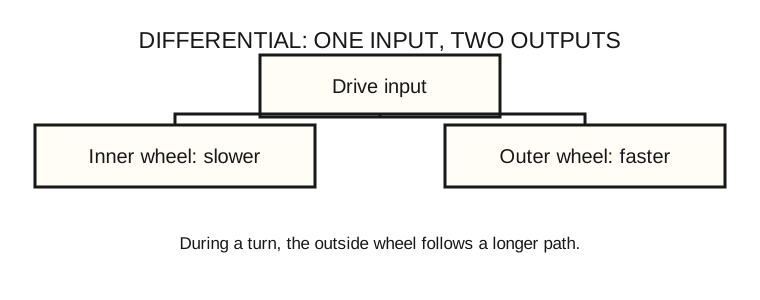
A turn gives the two wheels different distances
Imagine drawing the paths of a car’s left and right wheels around a corner. The outer path is longer. To cover their paths in the same time, the outer wheel must rotate faster, assuming equal effective tire sizes and normal rolling. Forcing both to the same speed would require some tire slip or mechanical strain.
An open differential uses gears to allow this speed difference while transferring drive. It performs a useful job even on a dry road. It is not simply an off-road accessory. Its location depends on the drive layout; a front-drive car can contain its differential within the transmission assembly.
Sources: Eaton ↗ · Subaru of America ↗
Unequal grip introduces another problem
Allowing different wheel speeds does not guarantee useful forward motion when one wheel has very little grip. An open differential can leave the vehicle limited by that low-grip wheel. Do not interpret its name as meaning that it actively chooses whichever tire can use the most drive.
Limited-slip designs restrict speed differences or redistribute drive within their operating limits. A locking differential can mechanically couple the outputs so they turn at the same speed while locked. Automatic and driver-selected designs work differently. Some vehicles also use individual-wheel braking to help manage wheelspin.
Sources: Eaton ↗ · Eaton ↗ · Transport Canada ↗ · Eaton ↗
Common misunderstandings
All-wheel drive does not mean all wheels always turn at the same speed. Turning requires the system to accommodate different wheel paths. How a vehicle handles those differences depends on its hardware and controls.
A differential cannot create tire grip. Even advanced systems remain limited by the tires and surface. A traction feature that helps a vehicle move away does not promise a shorter emergency stop. Choose the car’s tires and capabilities for your conditions, and assess handling and braking separately from its ability to accelerate.
Sources: Subaru of America ↗ · National Highway Traffic Safety Administration ↗ · Transport Canada ↗
Sources & review
Reviewed . Original educational explanation, checked against the sources below. This is general guidance; consult the documents for the exact vehicle, year, configuration, and market.
- What is an open differential?Eaton · What is an open differential?; Advantages. Simplified torque-to-least-resistance wording is not adopted. · Accessed 2026-10-22.
- What is All-Wheel Drive (AWD)?Subaru of America · How does AWD Work? · Accessed 2026-10-22.
- What is a locking differential?Eaton · Mechanical locking and equal axle speeds. Operating behavior differs among designs; marketing torque percentages are not adopted. · Accessed 2026-10-22.
- Electronic stability controlTransport Canada · How this technology works; Things for drivers to keep in mind · Accessed 2026-10-22.
- Automotive differentialsEaton · Open, limited-slip, and locking differential distinctions; marketing percentages not adopted · Accessed 2026-10-22.
- Buying a Used Car From a DealerFederal Trade Commission · Do Some Homework; Get an Independent Inspection Before You Buy; The Buyers Guide · Accessed 2026-10-22.
- Service Intervals and Oil Change IntervalsFord UK · When should I get my car serviced?; variable oil service intervals · Accessed 2026-10-22.
- Tire Safety Ratings and Awareness · TireWiseNational Highway Traffic Safety Administration · Tire Maintenance; Tire Pressure; Aging · Accessed 2026-10-22.