The short answer
Summer, winter, and all-season tires use different designs for different operating conditions. A suitable tire must also meet the vehicle’s approved specifications and remain in good condition. All-wheel drive cannot make an unsuitable tire behave like a suitable winter tire when braking or turning.
Rubber and tread work together
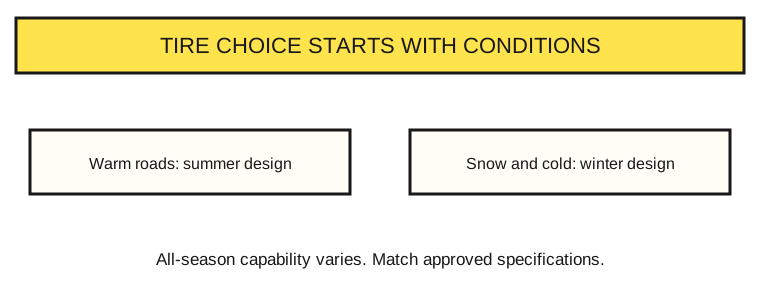
The tire is the car’s contact with the road. Its rubber compound and tread design influence how it works in different temperatures and on different surfaces. A useful choice starts with the conditions you expect, rather than with a universal claim that one category is best everywhere.
NHTSA describes summer tires as warm-weather products that are not intended for freezing conditions, snow, or ice. It also notes that winter tires are more effective than all-season tires in deep snow. These general distinctions do not rank every individual tire or promise grip in every winter situation.
Sources: National Highway Traffic Safety Administration ↗ · National Highway Traffic Safety Administration ↗
The seasonal category is only one part of the specification
The size, load capability, speed capability, and approved fitment still matter. A winter label does not permit a tire with an unsuitable load rating. Follow the vehicle’s instructions and applicable local requirements, including any rules for winter equipment in the places you will drive.
Tread condition, age, damage, and pressure also affect suitability. Check all the fitted tires rather than only the most visible pair. Use the vehicle’s cold-pressure guidance. Seasonal marketing words cannot compensate for a damaged tire or a set that does not match the required specification.
Sources: National Highway Traffic Safety Administration ↗ · National Highway Traffic Safety Administration ↗
Common misunderstandings
All-wheel drive helps distribute propulsion between axles. It does not provide a separate source of braking grip. Tire choice remains important on an all-wheel-drive vehicle, and a successful start on snow does not prove a short stopping distance.
All-season is not a promise of equal performance in all seasons. Read the exact product information and relevant markings. No tire removes the need to adjust driving to the conditions. Keep separate questions for seasonal capability, current condition, and whether the fitment meets the vehicle’s requirements.
Sources: Subaru of America ↗ · National Highway Traffic Safety Administration ↗ · National Highway Traffic Safety Administration ↗
Fifi’s first winter
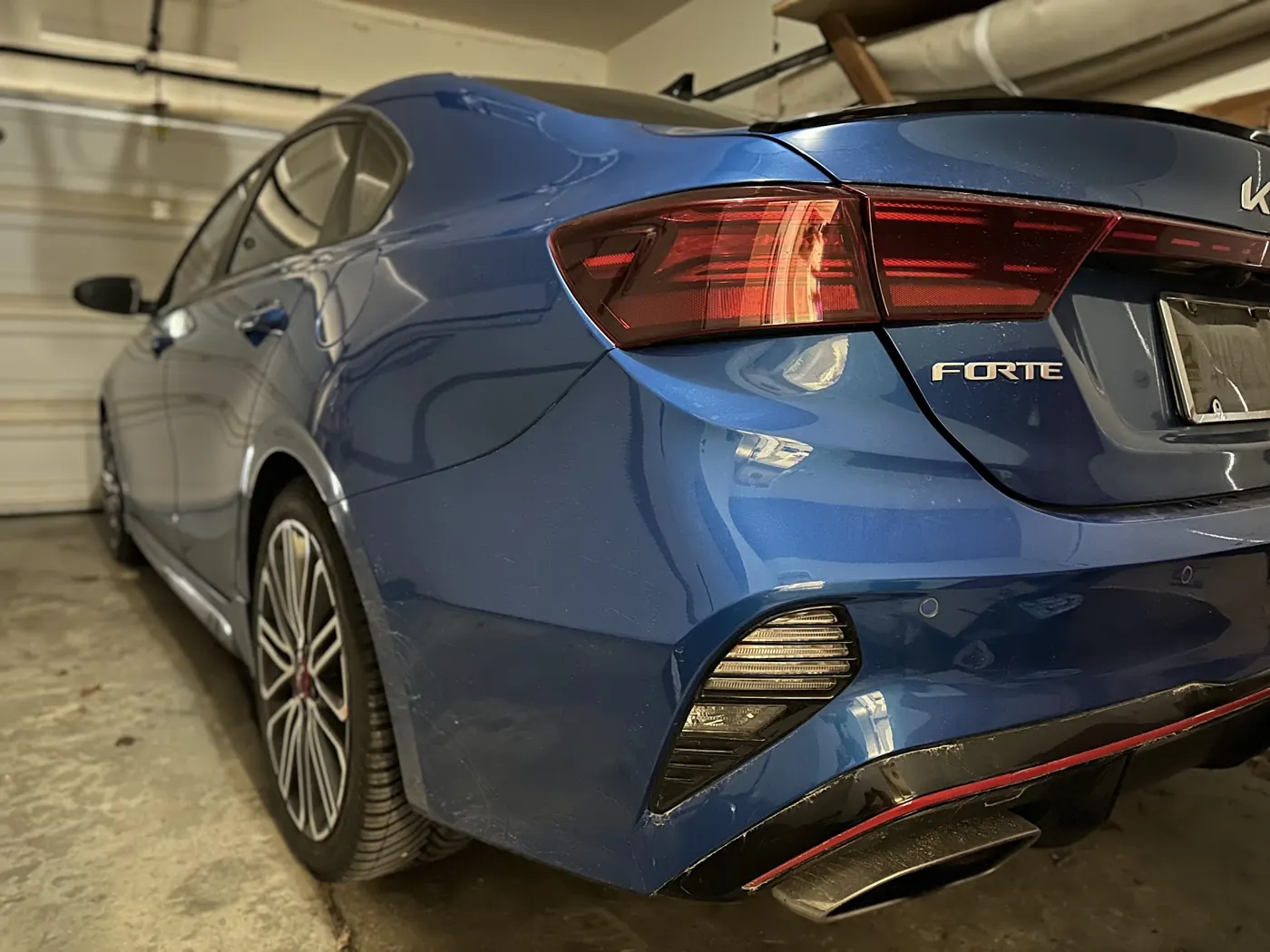
My car came with sport-tuned tires, Michelin Pilot Sport 4S, and I bought it in October. I found out very quickly that those were not going to work in a Michigan winter. The car slid around a lot. It was easy to spin the tires starting up, and the antilock brakes would sometimes fire on even slightly wet pavement.
Within a thousand miles I took it to Discount Tire and had a set of Michelin CrossClimate2 tires put on. Those gave the car a notably softer ride and made getting through modest amounts of snow much easier.
Selling the old set. I found a Kia Forte GT owners group on social media and found someone to sell the Pilot Sport 4S tires to. They had the GT with an automatic transmission, which did not come with the sport tires. It was a good transaction all around.
Why one set instead of two. I’m just not excited about switching tires twice a year if I can avoid it. The CrossClimate tires seem to be working fine in both winter and summer. And if the snow is really, really bad, I probably shouldn’t be driving my little sedan anyway.
Four years later. I’ve kept those CrossClimates ever since, rotated regularly, and they have carried most of the car’s 70,000 miles. They are just about due now, and I’m planning on a new set before this winter begins. I’ll likely stick with the same kind of tire.
Sources & review
Reviewed . Original educational explanation, checked against the sources below. This is general guidance; consult the documents for the exact vehicle, year, configuration, and market.
- Tire Safety Ratings and Awareness · TireWiseNational Highway Traffic Safety Administration · Tire Maintenance; Tire Pressure; Aging · Accessed 2026-10-22.
- Winter Weather Driving TipsNational Highway Traffic Safety Administration · Tires; Tire pressure; Before You Go. Federal consumer education used as factual base; no photos or text reproduced. · Accessed 2026-10-23.
- Do I need new tires? Performance upgradeMichelin USA · Plus sizing and manufacturer-approved alternative wheel diameters. No general tire upgrade recommendation adopted. · Accessed 2026-10-23.
- Vehicle Cost CalculatorU.S. Department of Energy · Alternative Fuels Data Center · Vehicle comparison inputs; cost assumptions and total ownership cost · Accessed 2026-10-22.
- What is All-Wheel Drive (AWD)?Subaru of America · How does AWD Work? · Accessed 2026-10-22.