The short answer
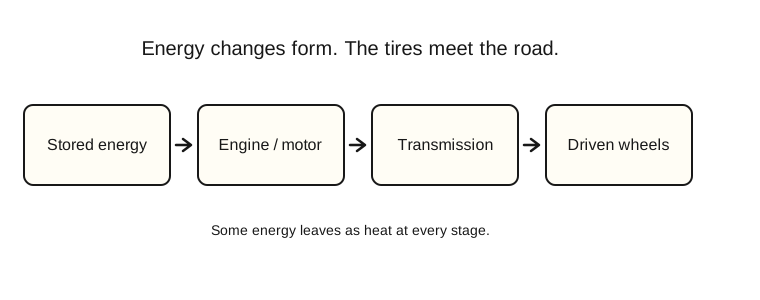
A car changes stored energy into rotation. Its driven tires push against the road, and the road pushes the car forward.
Start with stored energy
Gasoline stores chemical energy. An engine releases some of that energy by burning the fuel with air. Hot gas expands and pushes a piston, a part that slides inside a cylinder. A connecting rod links the piston to a rotating shaft called the crankshaft.
A battery electric car takes a different route. Its battery supplies electrical energy to a motor. The motor creates rotation without burning fuel inside the car. Both designs must deliver turning force to the wheels.
Sources: U.S. Department of Energy ↗ · U.S. Department of Energy ↗
Rotation becomes a push on the road
A transmission carries mechanical power toward the driven wheels. In a gasoline car it also lets the engine and wheels turn at different speeds. The tire’s contact with the road provides traction: the grip needed to turn wheel rotation into useful movement.
The energy does not all become forward movement. Some leaves as heat. Brakes later convert much of the car’s motion into heat, while regenerative braking can recover part of that energy as electricity.
Sources: U.S. Department of Energy ↗ · National Highway Traffic Safety Administration ↗ · Brembo Parts ↗ · U.S. Department of Energy ↗
Common misunderstandings
The accelerator does not directly command a road speed. It requests power or torque through the car’s controls. The resulting acceleration also depends on the car’s mass, gearing, grip, and resistance.
An electric car still has a drivetrain. It replaces the combustion engine with an electric motor, but it still needs a way to transfer rotation to its wheels.
Sources: U.S. Department of Energy ↗ · U.S. Department of Energy ↗
Sources & review
Reviewed . Original educational explanation, checked against the sources below. This is general guidance; consult the documents for the exact vehicle, year, configuration, and market.
- Internal Combustion Engine BasicsU.S. Department of Energy · How Does an Internal Combustion Engine Work? · Accessed 2026-10-22.
- How Do All-Electric Cars Work?U.S. Department of Energy · Alternative Fuels Data Center · Introduction and Key Components of an All-Electric Car · Accessed 2026-10-22.
- How Do Gasoline Cars Work?U.S. Department of Energy · Alternative Fuels Data Center · Introduction and Key Components of a Gasoline Car · Accessed 2026-10-22.
- Tire Safety Ratings and Awareness · TireWiseNational Highway Traffic Safety Administration · Tire Maintenance; Tire Pressure; Aging · Accessed 2026-10-22.
- What causes brake discs to overheat and how to avoid itBrembo Parts · Friction, heat, and brake performance · Accessed 2026-10-22.
- How Do Hybrid Electric Cars Work?U.S. Department of Energy · Alternative Fuels Data Center · Introduction, Electric generator, and Transmission · Accessed 2026-10-22.