The short answer
A gear ratio describes the relationship between input and output rotation. A reduction makes the output turn more slowly and can increase its torque. This does not create power: speed and torque trade against each other, and real mechanisms lose some energy. Check how a published ratio is defined before comparing numbers.
Define the ratio before doing the arithmetic
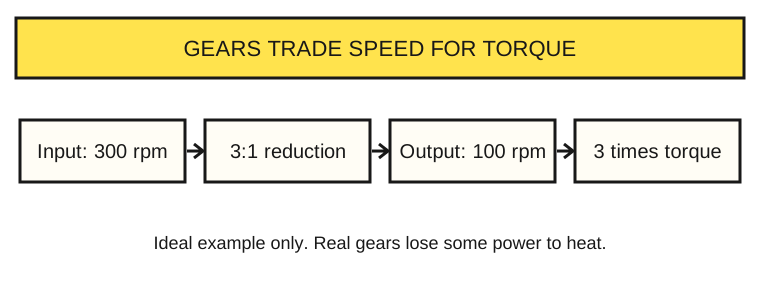
Here a 3:1 reduction means three input revolutions for each output revolution. If the input turns at 300 revolutions per minute, or rpm, the output turns at 100 rpm. Technical documents can describe ratios in different ways, so read their definitions rather than assuming every table follows the same convention.
In an ideal loss-free reduction, output torque rises by the same factor that output speed falls. For this example, 10 newton-meters at the input becomes 30 newton-meters at the output. Real gears deliver less output power than input power because some energy becomes heat. The example demonstrates a relationship, not a particular car’s specification.
Sources: University of California San Diego ↗ · Tom Weideman ↗
The whole path determines wheel behavior
A combustion engine works over a useful range of rotational speeds. The transmission changes the speed relationship between that engine and the wheels. A lower road gear provides more reduction for starting or climbing; a higher road gear allows less engine rotation for a given wheel speed.
In a conventional driveline, the selected transmission ratio combines with the final-drive ratio. Tire rolling size then links wheel rotation to distance traveled. A single ratio in a brochure therefore does not establish road speed or acceleration by itself. Engine output and vehicle conditions also matter.
Sources: U.S. Environmental Protection Agency ↗ · University of California San Diego ↗ · National Highway Traffic Safety Administration ↗
Common misunderstandings
Gears can multiply torque while reducing speed. They cannot multiply power without another energy source. This is why engine torque and torque at the wheels are different figures and should not be compared without explaining the measurement point.
An electric car can use a fixed reduction and still have a transmission mechanism. A broad motor operating range can reduce the need for several selectable road gears. That does not mean its motor connects directly to the tires with no intervening components. Check the particular vehicle’s arrangement.
Sources: University of California San Diego ↗ · U.S. Department of Energy ↗
Sources & review
Reviewed . Original educational explanation, checked against the sources below. This is general guidance; consult the documents for the exact vehicle, year, configuration, and market.
- Gear RatiosUniversity of California San Diego · MAE 3 · Energy and Power Equations; Analysis of a Gear Pair; Summary. Mathematical facts only; no teaching artwork or exercise adapted. · Accessed 2026-10-22.
- 5.5: TorqueTom Weideman · University of California, Davis · Physics LibreTexts · Rotational Power: power equals torque times angular velocity · Accessed 2026-10-22.
- Advanced Gasoline and Diesel VehiclesU.S. Environmental Protection Agency · Turbocharging and Advanced Transmissions · Accessed 2026-10-22.
- Tire Safety Ratings and Awareness · TireWiseNational Highway Traffic Safety Administration · Tire Maintenance; Tire Pressure; Aging · Accessed 2026-10-22.
- CVTHonda Motor Co. · A Transmission Contributing to Outstanding Fuel Efficiency and Smooth Driving · Accessed 2026-10-22.
- How Do Hybrid Electric Cars Work?U.S. Department of Energy · Alternative Fuels Data Center · Introduction, Electric generator, and Transmission · Accessed 2026-10-22.
- Buying a Used Car From a DealerFederal Trade Commission · Do Some Homework; Get an Independent Inspection Before You Buy; The Buyers Guide · Accessed 2026-10-22.
- How Do All-Electric Cars Work?U.S. Department of Energy · Alternative Fuels Data Center · Introduction and Key Components of an All-Electric Car · Accessed 2026-10-22.