The short answer
Torque measures a turning effect. Power measures how quickly work happens. Horsepower is one unit of power; a kilowatt is another.
Torque is a turning effect
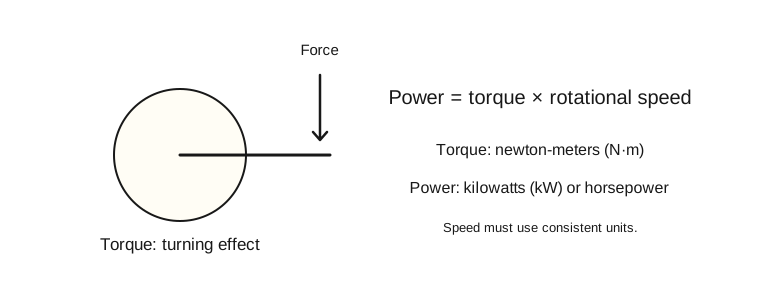
A force applied with a perpendicular lever arm from a shaft’s center creates torque. Engine specifications often express it in newton-meters, written N·m, or pound-feet. A longer lever needs less force to make the same torque. This lever example explains a turning effect; it does not describe the full behavior of an engine.
A transmission changes the torque and speed available at the wheels. That is why an engine’s quoted torque is not the same thing as the turning effect at a driven wheel.
Sources: NASA Glenn Research Center ↗ · U.S. Environmental Protection Agency ↗
Power adds the rate of rotation
For a rotating shaft, power depends on torque and rotational speed together. Engine speed is commonly stated in revolutions per minute, or rpm. A specification such as “150 kW at 6,000 rpm” states the power produced at that engine speed. It does not promise the same power at every speed.
A kilowatt, written kW, equals 1,000 watts. One mechanical horsepower is about 746 watts. Metric horsepower, sometimes labeled PS, is about 735 watts. Check which unit a listing uses before comparing numbers across markets.
Sources: Tom Weideman ↗ · NASA Glenn Research Center ↗ · National Institute of Standards and Technology ↗
Common misunderstandings
Torque and power are related, but they are not interchangeable. You cannot directly compare 250 N·m with 150 kW because they measure different quantities.
Do not add a hybrid’s separate engine and motor peak ratings unless the manufacturer identifies that sum as the system output. Their peaks may occur at different operating points. Compare the stated combined rating.
Sources & review
Reviewed . Original educational explanation, checked against the sources below. This is general guidance; consult the documents for the exact vehicle, year, configuration, and market.
- Torque (Moment)NASA Glenn Research Center · Definition of torque and perpendicular lever arm · Accessed 2026-10-22.
- Advanced Gasoline and Diesel VehiclesU.S. Environmental Protection Agency · Turbocharging and Advanced Transmissions · Accessed 2026-10-22.
- 5.5: TorqueTom Weideman · University of California, Davis · Physics LibreTexts · Rotational Power: power equals torque times angular velocity · Accessed 2026-10-22.
- What is Power?NASA Glenn Research Center · Definition of power and units · Accessed 2026-10-22.
- Guide to the SI, Appendix B.9: Conversion FactorsNational Institute of Standards and Technology · Power: horsepower and metric horsepower · Accessed 2026-10-22.