The short answer
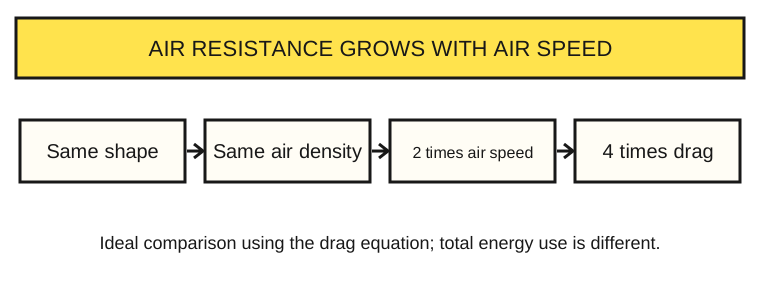
A moving car pushes through air and experiences aerodynamic drag, a force opposing its motion relative to that air. Drag depends on shape, size, air density, and relative air speed. At otherwise equal conditions, the drag equation makes drag proportional to the square of air speed. Total fuel or electricity use includes other demands too.
Air speed matters in a specific mathematical way
The standard drag equation combines a drag coefficient, air density, a reference area, and the square of speed relative to the air. Keep all the other inputs fixed and double that speed: the calculated drag force becomes four times as large. This is an illustration of the equation, not an instruction to test high speeds.
Wind changes the air speed experienced by a car. A headwind can increase it even when road speed stays the same. The equation describes aerodynamic force. It does not say that total fuel consumption or total electricity use must quadruple, because those totals contain other effects and depend on the distance or time being compared.
Sources: NASA Glenn Research Center ↗ · U.S. Department of Energy / U.S. Environmental Protection Agency ↗
A coefficient needs its reference area
The drag coefficient, often written Cd, describes aerodynamic behavior within a defined measurement setup. It has no unit such as liters or kilograms. The reference area represents size. Both appear in the equation, so a lower coefficient alone does not prove a larger car has less drag than a smaller one.
Tires, acceleration, gradients, powertrain losses, and cabin equipment also affect energy use. A smooth-looking body therefore cannot establish the car’s complete efficiency. Compare standardized consumption information for the actual version, then consider how your driving differs from the test conditions.
Sources: NASA Glenn Research Center ↗ · U.S. Department of Energy / U.S. Environmental Protection Agency ↗ · U.S. Department of Energy / U.S. Environmental Protection Agency ↗
Common misunderstandings
Low drag and low weight describe different properties. Weight matters to several driving demands, while drag concerns motion through air. Neither specification replaces a full vehicle comparison.
An aerodynamic claim should identify the version and configuration measured. Wheels, external equipment, and test conditions can affect the result. Ask what the number includes. Use the physics to understand why consumption changes, while using appropriate vehicle evidence to estimate how much it changes in your journeys.
Sources: NASA Glenn Research Center ↗ · U.S. Department of Energy / U.S. Environmental Protection Agency ↗ · U.S. Department of Energy / U.S. Environmental Protection Agency ↗
Sources & review
Reviewed . Original educational explanation, checked against the sources below. This is general guidance; consult the documents for the exact vehicle, year, configuration, and market.
- Drag EquationNASA Glenn Research Center · Drag equation and Drag Coefficient: relative air speed, density, area and coefficient. Government educational facts only. · Accessed 2026-10-22.
- Your Mileage Will VaryU.S. Department of Energy / U.S. Environmental Protection Agency · FuelEconomy.gov · Opening explanation: standardized estimates versus real-world results · Accessed 2026-10-22.
- Gasoline Vehicles: Learn More About the LabelU.S. Department of Energy / U.S. Environmental Protection Agency · FuelEconomy.gov · 2. Fuel Economy; 4. You Save/Spend More Over 5 Years; 5. Fuel Consumption Rate; 6. Estimated Annual Fuel Cost · Accessed 2026-10-22.
- Electric & Plug-In Hybrid Electric VehiclesU.S. Environmental Protection Agency · Driving Range · Accessed 2026-10-22.
- Driving More EfficientlyU.S. Department of Energy / U.S. Environmental Protection Agency · FuelEconomy.gov · Observe the Speed Limit; Avoid Hauling Cargo on Your Roof. Government education; no percentage claims or artwork reproduced. · Accessed 2026-10-22.
- Vehicle Cost CalculatorU.S. Department of Energy · Alternative Fuels Data Center · Vehicle comparison inputs; cost assumptions and total ownership cost · Accessed 2026-10-22.