The short answer
Fuel economy measures how far a car travels for a quantity of fuel. Energy consumption measures how much it uses over a distance. Ratings help you compare cars under stated test conditions; they do not promise your exact result.
Know which way the number works
Miles per gallon, abbreviated mpg, describes distance per fuel quantity. A larger number means less fuel is needed for the same distance. Liters per 100 kilometers describes fuel quantity per distance. Here, a smaller number means less fuel use. Never compare the bare numbers without reading the units.
Check the gallon as well. A US gallon and an Imperial gallon are different quantities. A UK listing and a US listing can show different mpg numbers even when they describe the same underlying consumption. Use matching units and a matching test procedure.
Sources: U.S. Department of Energy / U.S. Environmental Protection Agency ↗ · National Institute of Standards and Technology ↗
Use a distance to make the comparison concrete
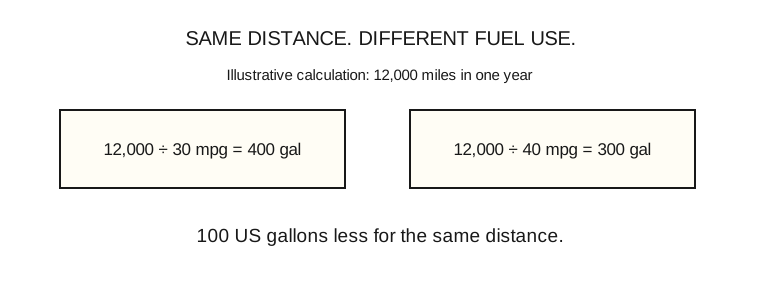
Suppose you travel 12,000 miles in a year. At 30 miles per US gallon, the arithmetic gives 400 US gallons. At 40 miles per US gallon, it gives 300 US gallons. The difference is 100 US gallons. These are illustrative calculations, not specifications for real vehicles.
For an electric car, a label may show kilowatt-hours per 100 miles. A kilowatt-hour, written kWh, is energy. Multiply that figure by your distance divided by 100 to estimate energy consumption under the stated conditions. Miles per gallon equivalent, or MPGe, compares energy amounts across fuels. It does not mean that electricity and gasoline cost the same.
Sources: U.S. Department of Energy / U.S. Environmental Protection Agency ↗ · U.S. Department of Energy / U.S. Environmental Protection Agency ↗
Common misunderstandings
A label’s combined result is not a guarantee for every trip. A short cold journey can differ from a warm highway journey. Do not diagnose a mechanical fault from a single disappointing trip alone.
MPGe is not an electric car’s driving range. Range describes distance available from a charge under stated conditions. Energy efficiency describes how effectively the car uses energy. Read both figures and their units.
Sources: U.S. Department of Energy / U.S. Environmental Protection Agency ↗ · U.S. Department of Energy / U.S. Environmental Protection Agency ↗
Sources & review
Reviewed . Original educational explanation, checked against the sources below. This is general guidance; consult the documents for the exact vehicle, year, configuration, and market.
- Gasoline Vehicles: Learn More About the LabelU.S. Department of Energy / U.S. Environmental Protection Agency · FuelEconomy.gov · 2. Fuel Economy; 4. You Save/Spend More Over 5 Years; 5. Fuel Consumption Rate; 6. Estimated Annual Fuel Cost · Accessed 2026-10-22.
- Guide to the SI, Appendix B.9: Fuel Consumption and VolumeNational Institute of Standards and Technology · Fuel Consumption; Volume: gallon (U.K.) and gallon (U.S.) conversion factors · Accessed 2026-10-22.
- Electric Vehicles: Learn More About the LabelU.S. Department of Energy / U.S. Environmental Protection Agency · FuelEconomy.gov · 2. Fuel Economy; energy consumption, driving range and charge time sections · Accessed 2026-10-22.
- Your Mileage Will VaryU.S. Department of Energy / U.S. Environmental Protection Agency · FuelEconomy.gov · Opening explanation: standardized estimates versus real-world results · Accessed 2026-10-22.
- Vehicle Cost CalculatorU.S. Department of Energy · Alternative Fuels Data Center · Vehicle comparison inputs; cost assumptions and total ownership cost · Accessed 2026-10-22.