The short answer
Capacity describes how much energy a battery can store. Power describes how quickly energy is delivered or used. Driving range depends on usable energy and the car’s energy consumption under the conditions of the journey.
Capacity is an energy quantity
A battery specification often lists kilowatt-hours, written kWh. This is a quantity of energy. A kilowatt, written kW, is a rate of energy transfer. The two units answer different questions. Capacity helps describe the energy available; power helps describe how quickly energy can be used or replenished.
Check the definition beside the battery number. A usable-capacity figure is the relevant starting point for a simple driving calculation. Do not assume that every brochure or used-car advertisement states capacity on the same basis. Ask the manufacturer which figure applies to the exact version.
Sources: NASA Glenn Research Center ↗ · U.S. Environmental Protection Agency ↗
Range needs a consumption figure too
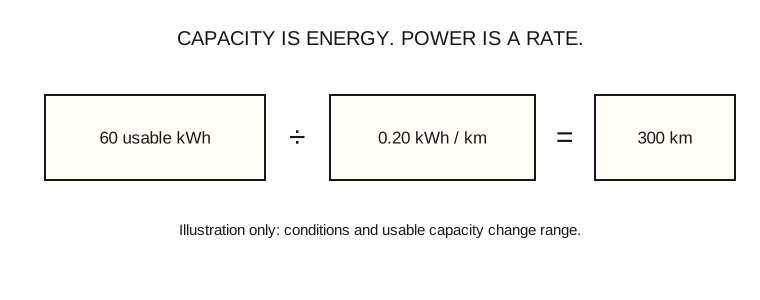
Consider a fictional car with 60 kWh of usable energy. If it uses 0.20 kWh per kilometer, dividing 60 by 0.20 gives 300 kilometers. This is arithmetic for the stated assumptions, not a prediction for a real car. If energy use rises, the same energy takes the car a shorter distance.
Temperature, road speed, and heating or cooling use can affect real driving range. A published test estimate helps compare cars within that test system. A dashboard estimate responds to the car’s assumptions and available information. Neither guarantees that the next journey will match a particular number.
Sources: U.S. Environmental Protection Agency ↗ · U.S. Environmental Protection Agency ↗
Common misunderstandings
A display showing 100% charge does not mean that the battery is in as-new condition. State of charge describes the present charge level. Condition concerns what energy and performance the battery can still provide; these are different questions.
A 60 kWh battery does not necessarily accept 60 kW of charging power. Read the charging specification separately. A faster advertised charger cannot override the car’s own limit. Planning a useful charging stop requires more information than capacity alone.
Sources: U.S. Environmental Protection Agency ↗ · U.S. Department of Energy ↗ · U.S. Department of Energy ↗
Sources & review
Reviewed . Original educational explanation, checked against the sources below. This is general guidance; consult the documents for the exact vehicle, year, configuration, and market.
- What is Power?NASA Glenn Research Center · Definition of power and units · Accessed 2026-10-22.
- Plug-in Electric Vehicle Charging: The DetailsU.S. Environmental Protection Agency · Volts, Amps, and Watts. Oh My.: battery capacity, power limits and range calculation · Accessed 2026-10-22.
- Electric & Plug-In Hybrid Electric VehiclesU.S. Environmental Protection Agency · Driving Range · Accessed 2026-10-22.
- Maintenance and Safety of Electric VehiclesU.S. Department of Energy · Alternative Fuels Data Center · Maintenance Comparison and Battery Maintenance · Accessed 2026-10-22.
- Electric Vehicle Charging StationsU.S. Department of Energy · Alternative Fuels Data Center · Charging Equipment: AC Level 1, AC Level 2, DC Fast Charging; charging-time variables · Accessed 2026-10-22.