The short answer
Electric vehicle (EV) charging transfers electrical energy into the car’s battery. The connection, vehicle, charging equipment, and battery conditions limit how quickly that can happen. A connector that fits is only one part of compatibility.
Where the conversion happens
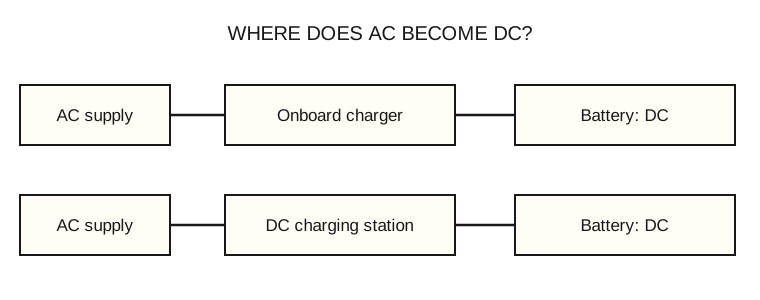
Charging the traction battery requires direct current, abbreviated DC. Many electricity supplies provide alternating current, abbreviated AC. With AC charging, the car’s onboard charger performs the conversion needed to charge the battery. With DC charging, that conversion happens in external charging equipment.
In U.S. terminology, AC Level 1 typically uses 120 volts. AC Level 2 uses higher-voltage service, commonly 240 volts at a home. DC fast charging is a separate charging method. Other countries use different supply arrangements and naming conventions. The label Level 2 does not identify one universal connector or power output.
Sources: U.S. Department of Energy ↗ · U.S. Department of Energy ↗
A power rating is a ceiling, not a promise
Charging power is a rate, normally stated in kilowatts, or kW. Battery energy is stated in kilowatt-hours, or kWh. These are different quantities. If 14 kWh entered a battery at a constant 7 kW, the ideal calculation would give two hours. Real sessions include losses and may not hold a constant rate.
A car cannot necessarily use all the power advertised on a charging station. Its charging system, battery temperature, and state of charge can limit the accepted rate. State of charge means how full the battery is within its usable range. Compare the charging conditions and start and end percentages behind a quoted time.
Sources: NASA Glenn Research Center ↗ · U.S. Environmental Protection Agency ↗ · U.S. Department of Energy ↗
Common misunderstandings
A battery’s capacity does not tell you its maximum charging power. A larger battery may store more energy without accepting a higher charging rate. Read the separate specifications.
Charging every night does not necessarily mean charging from empty to full. Your routine usually replaces energy used since the previous session. Choose equipment around your actual journeys and available parking time, while following the manufacturer’s charging advice.
Sources: U.S. Environmental Protection Agency ↗ · U.S. Department of Energy ↗
Sources & review
Reviewed . Original educational explanation, checked against the sources below. This is general guidance; consult the documents for the exact vehicle, year, configuration, and market.
- How Do All-Electric Cars Work?U.S. Department of Energy · Alternative Fuels Data Center · Introduction and Key Components of an All-Electric Car · Accessed 2026-10-22.
- Electric Vehicle Charging StationsU.S. Department of Energy · Alternative Fuels Data Center · Charging Equipment: AC Level 1, AC Level 2, DC Fast Charging; charging-time variables · Accessed 2026-10-22.
- What is Power?NASA Glenn Research Center · Definition of power and units · Accessed 2026-10-22.
- Plug-in Electric Vehicle Charging: The DetailsU.S. Environmental Protection Agency · Volts, Amps, and Watts. Oh My.: battery capacity, power limits and range calculation · Accessed 2026-10-22.
- Charging Electric Vehicles at HomeU.S. Department of Energy · Alternative Fuels Data Center · Installing Charging Equipment in Your Home; Complying with Regulations; Electricity Costs for Charging · Accessed 2026-10-22.