The short answer
A common continuously variable transmission, or CVT, uses two adjustable pulleys linked by a steel belt. Changing the effective pulley diameters changes the speed ratio without requiring a series of fixed gear steps. The term CVT covers more than this one design, and a hybrid e-CVT does not automatically contain a belt.
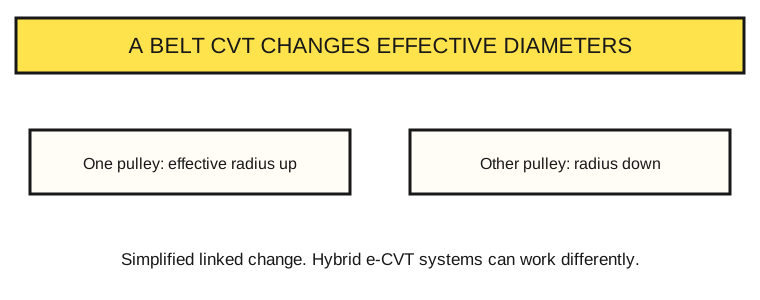
Changing the belt’s running radius changes the ratio
Each pulley has faces that can move closer together or farther apart. Their spacing changes where the belt runs between them. A larger effective radius means the belt travels farther for one pulley revolution. Coordinating both pulleys therefore changes the relationship between input and output rotation.
Nissan’s archived XTRONIC example uses a steel belt and variable-width pulleys. Other continuously variable mechanisms can use different parts. The illustration explains one common arrangement, not a physical map of every transmission carrying a CVT badge.
Sources: Nissan Motor Corporation ↗ · Honda Motor Co. ↗ · University of California San Diego ↗
The controls can choose ratio without fixed shift points
A stepped transmission moves between a set of ratios. A continuously variable mechanism can select intermediate ratios within its operating range. This lets engine speed and road speed change in a relationship that may feel unfamiliar after a conventional stepped automatic.
A hybrid’s electronically controlled transmission can achieve variable operation through another arrangement. Toyota’s cited system uses two motors and a mechanical power-split design. Do not infer a steel belt from the name e-CVT, and do not assume every hybrid uses Toyota’s mechanism. Identify the actual system on the car.
Sources: Honda Motor Co. ↗ · Toyota Motor Corporation ↗ · U.S. Department of Energy ↗
Common misunderstandings
Continuously variable does not mean the mechanism has an unlimited ratio range. Its design still sets limits. It also does not mean the transmission makes power: it changes the speed and torque relationship while real losses remain.
A transmission category is not a reliability verdict. Different designs, years, servicing, and operating conditions matter. Compare the actual car’s behavior and evidence rather than assuming every CVT is either trouble-free or defective. Keep preferences about sound and feel separate from a professional assessment of condition.
Sources: Nissan Motor Corporation ↗ · University of California San Diego ↗ · Federal Trade Commission ↗
Sources & review
Reviewed . Original educational explanation, checked against the sources below. This is general guidance; consult the documents for the exact vehicle, year, configuration, and market.
- XTRONIC CVTNissan Motor Corporation · Technology Configuration: pulley widths, steel belt and changing ratio. Archived product example, not every CVT. · Accessed 2026-10-23.
- CVTHonda Motor Co. · A Transmission Contributing to Outstanding Fuel Efficiency and Smooth Driving · Accessed 2026-10-22.
- Gear RatiosUniversity of California San Diego · MAE 3 · Energy and Power Equations; Analysis of a Gear Pair; Summary. Mathematical facts only; no teaching artwork or exercise adapted. · Accessed 2026-10-22.
- 2.0-liter Toyota Hybrid System (THS II)Toyota Motor Corporation · New Transaxle: two-motor mechanical power-split design. Not all hybrids or all e-CVTs use this layout. · Accessed 2026-10-23.
- How Do Hybrid Electric Cars Work?U.S. Department of Energy · Alternative Fuels Data Center · Introduction, Electric generator, and Transmission · Accessed 2026-10-22.
- Buying a Used Car From a DealerFederal Trade Commission · Do Some Homework; Get an Independent Inspection Before You Buy; The Buyers Guide · Accessed 2026-10-22.
- Service Intervals and Oil Change IntervalsFord UK · When should I get my car serviced?; variable oil service intervals · Accessed 2026-10-22.