The short answer
Viscosity describes a fluid’s resistance to flow. An engine-oil grade such as 0W-20 describes performance in specified low- and high-temperature viscosity tests. It is not a temperature range or a complete quality rating. The correct oil must also meet the engine’s required performance specifications and approvals.
Two parts of the grade describe different tests
Engine oil must move around the engine and maintain suitable lubrication under changing conditions. Temperature affects how readily it flows. A multigrade oil carries ratings for specified cold behavior and for viscosity at a higher test temperature, rather than keeping one unchanged thickness in all conditions.
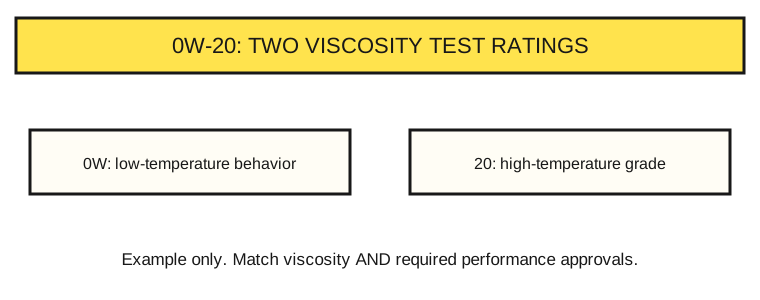
In 0W-20, W refers to winter performance under the grading system. The 0W part concerns low-temperature behavior. The 20 part is a high-temperature viscosity grade. Neither number is a direct reading in degrees Celsius, and 0W does not mean the oil has no viscosity.
Sources: Castrol USA ↗ · Cleveland State University ↗
The grade does not describe every oil property
Two containers carrying the same viscosity grade can meet different performance requirements. Engine designs and emissions equipment can need particular oil formulations. Check the complete specification in the manual or manufacturer service information, rather than matching only the large number on the front of a bottle.
A description such as synthetic also does not replace those requirements. The maintenance schedule determines when the correct oil and filter need service. A more expensive product or a different viscosity does not authorize extending an interval beyond the vehicle’s instructions.
Sources: Ford UK ↗ · Cleveland State University ↗ · Toyota Motor Sales ↗ · American Petroleum Institute ↗
Common misunderstandings
Thicker is not automatically more protective, and thinner is not automatically more efficient for every engine. The manufacturer specifies oil for a complete design. Do not transfer a recommendation from another model because its engine has a similar displacement.
A viscosity grade is not an oil-change interval. It also does not tell you how much oil the engine holds or how to check its level. Those are separate instructions. Follow the correct checking conditions and warning response; an oil-pressure warning is not simply a request to choose a different grade.
Sources: Castrol USA ↗ · Ford UK ↗ · Ford Motor Company ↗
Sources & review
Reviewed . Original educational explanation, checked against the sources below. This is general guidance; consult the documents for the exact vehicle, year, configuration, and market.
- What is 0W-20 motor oil?Castrol USA · 0W-20 grade: low-temperature measurement and higher-temperature viscosity. Historical market claims excluded. · Accessed 2026-10-23.
- Engine LubricationCleveland State University · Mechanical Engineering · Fuel Economy through Engine Oil Formulation · Accessed 2026-10-22.
- Service Intervals and Oil Change IntervalsFord UK · When should I get my car serviced?; variable oil service intervals · Accessed 2026-10-22.
- Basic Car Maintenance Tips & Services ChecklistToyota Motor Sales · 10. Inspect Your Belts and Hoses; 13. Replace Your Engine Air Filter; 14. Check Your Spark Plugs. Generic intervals and unqualified fuel-economy claims are not adopted. · Accessed 2026-10-22.
- API’s Motor Oil Guide, 2025 editionAmerican Petroleum Institute · PDF page 3, API’s Service Symbol: performance level and viscosity grade are separate label fields. Category status tables not adopted as current guidance. · Accessed 2026-10-23.
- Buying a Used Car From a DealerFederal Trade Commission · Do Some Homework; Get an Independent Inspection Before You Buy; The Buyers Guide · Accessed 2026-10-22.
- Instrument Cluster — Warning Lamps and IndicatorsFord Motor Company · online owner manual · Warning Lamps and Indicators; Engine Oil Warning Lamp; Malfunction Indicator Lamp; Scheduled Maintenance Indicator Lamp · Accessed 2026-10-22.