The short answer
A traction battery works within a controlled temperature range. A vehicle’s thermal-management system limits temperature extremes using the equipment fitted to that model. Temperature affects performance and charging, while heating or cooling can use energy. Battery temperature control is separate from how much charge the dashboard currently shows.
Temperature is an operating condition
The battery is a collection of cells managed by hardware and software. Its controls monitor operating conditions rather than treating stored energy as the only relevant number. Extreme temperatures can affect performance and battery life. Managing temperature helps keep the pack within its intended conditions.
The equipment differs by vehicle. Some designs use circulating liquid and heat exchangers; others use different cooling arrangements. A thermal system may also manage the electric motor and power electronics. Do not infer the complete design from a visible reservoir or from the fact that the cabin has air conditioning.
Sources: National Highway Traffic Safety Administration ↗ · U.S. Department of Energy ↗
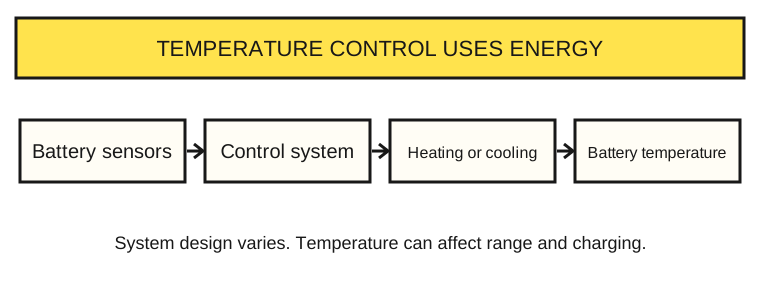
Heating and cooling share the energy budget
Energy spent managing temperatures is not available for propulsion at that moment. Cabin heating adds another demand in cold weather. A winter journey can therefore have different energy consumption from a mild-weather journey, even on the same route.
Preconditioning prepares temperature before driving or charging when supported. The controls, timing, and connection requirements depend on the car. Preparing a plugged-in vehicle can use external energy for some of that work. It does not make heating free, and it does not guarantee a particular charging rate in every condition.
Sources: U.S. Department of Energy ↗ · National Highway Traffic Safety Administration ↗ · U.S. Department of Energy ↗
Common misunderstandings
State of charge describes the energy level relative to the battery’s managed usable range. It does not tell you the pack’s temperature or establish how much capacity it retains compared with when new. These are separate questions for the vehicle’s data and inspection procedures.
A battery-electric car still has temperature-sensitive components and model-specific maintenance. It may need fluid checks or other thermal-system care even though it has no engine oil changes. Follow its own schedule and specified fluids. Never open or work on high-voltage equipment as a buying check; use appropriately qualified service support.
Sources: U.S. Environmental Protection Agency ↗ · National Highway Traffic Safety Administration ↗ · U.S. Department of Energy ↗
Sources & review
Reviewed . Original educational explanation, checked against the sources below. This is general guidance; consult the documents for the exact vehicle, year, configuration, and market.
- Electric and Hybrid VehiclesNational Highway Traffic Safety Administration · Battery Lifespan and Types; Batteries and Temperature. Thermal management energy use; no lifespan prediction adopted. · Accessed 2026-10-22.
- How Do All-Electric Cars Work?U.S. Department of Energy · Alternative Fuels Data Center · Introduction and Key Components of an All-Electric Car · Accessed 2026-10-22.
- Winterizing Your Electric VehicleU.S. Department of Energy · Heat pump versus resistance heating; battery preconditioning and cabin warming. Federal education used as factual base; no illustrations reproduced. · Accessed 2026-10-22.
- Electric Vehicle Charging StationsU.S. Department of Energy · Alternative Fuels Data Center · Charging Equipment: AC Level 1, AC Level 2, DC Fast Charging; charging-time variables · Accessed 2026-10-22.
- Maintenance and Safety of Electric VehiclesU.S. Department of Energy · Alternative Fuels Data Center · Maintenance Comparison and Battery Maintenance · Accessed 2026-10-22.
- Buying a Used Car From a DealerFederal Trade Commission · Do Some Homework; Get an Independent Inspection Before You Buy; The Buyers Guide · Accessed 2026-10-22.
- Plug-in Electric Vehicle Charging: The DetailsU.S. Environmental Protection Agency · Volts, Amps, and Watts. Oh My.: battery capacity, power limits and range calculation · Accessed 2026-10-22.