The short answer
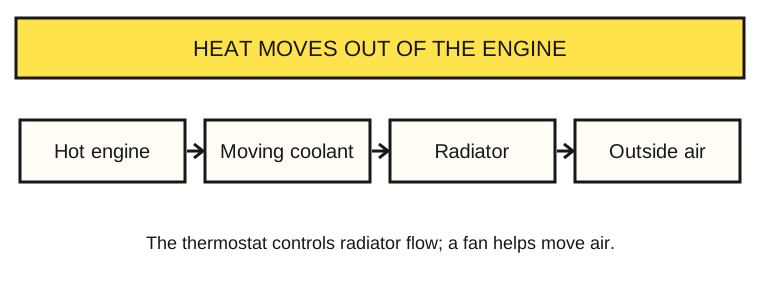
A liquid-cooled engine transfers some of its heat into coolant. A pump circulates that fluid. A radiator transfers heat from the coolant to outside air. A thermostat regulates flow toward the radiator, while a fan helps air pass through it when needed. The aim is a controlled operating temperature.
The fluid carries heat; the radiator releases it
Combustion produces heat as well as useful mechanical work. Coolant travels through passages around hot engine parts and carries some of that heat away. The radiator provides a large heat-transfer area exposed to air. Heat passes through its surfaces into the airflow.
Moving the car often supplies useful airflow. A cooling fan can supply extra airflow, particularly while the car is stationary. Fluid circulation and airflow are separate requirements. A full coolant reservoir alone cannot show that the pump, radiator, fan, and controls all work correctly.
Sources: U.S. Department of Energy ↗ · DENSO Europe ↗
Control matters as much as cooling capacity
The thermostat regulates coolant flow to the radiator as conditions change. During warm-up, limiting that flow helps the engine reach its intended operating temperature. The cooling system is not simply trying to make the engine as cold as possible.
Hoses, seals, caps, and connections also form part of the system. Use the coolant specification and checking procedure for the exact vehicle. Color alone does not establish compatibility. Some vehicles have several separate fluid circuits, so a tank visible under the hood is not automatically the engine coolant reservoir.
Sources: DENSO Europe ↗ · Ford Motor Company ↗ · U.S. Department of Energy ↗
Common misunderstandings
Low coolant is not a diagnosis of a failed radiator. Leakage or another fault may involve a different component. Adding fluid without finding the cause can leave the underlying problem unresolved. An inspector may need further tests before giving a reliable repair estimate.
Coolant and refrigerant perform different jobs. Engine coolant carries heat through the engine cooling system. Air-conditioning refrigerant circulates through a refrigeration system. Some vehicles connect their thermal systems through heat exchangers, but the fluids are not interchangeable. Follow the model’s schedule rather than a universal coolant replacement interval.
Sources: DENSO Europe ↗ · DENSO Europe ↗ · Ford UK ↗
Sources & review
Reviewed . Original educational explanation, checked against the sources below. This is general guidance; consult the documents for the exact vehicle, year, configuration, and market.
- Internal Combustion Engine BasicsU.S. Department of Energy · How Does an Internal Combustion Engine Work? · Accessed 2026-10-22.
- Cooling RadiatorsDENSO Europe · How radiators work; Fault finding · Accessed 2026-10-22.
- ThermostatsDENSO Europe · How Thermostats work; Types and characteristics · Accessed 2026-10-22.
- Maintenance — Engine Coolant CheckFord Motor Company · online owner manual · Engine Coolant Check: opening scalding warning and fluid-specification instruction. Only these general principles are used, not the model-specific filling procedure. · Accessed 2026-10-22.
- How Do All-Electric Cars Work?U.S. Department of Energy · Alternative Fuels Data Center · Introduction and Key Components of an All-Electric Car · Accessed 2026-10-22.
- Buying a Used Car From a DealerFederal Trade Commission · Do Some Homework; Get an Independent Inspection Before You Buy; The Buyers Guide · Accessed 2026-10-22.
- DENSO: the real A/C SpecialistsDENSO Europe · How do air-conditioning systems work? Generic service intervals are not adopted. · Accessed 2026-10-22.
- Service Intervals and Oil Change IntervalsFord UK · When should I get my car serviced?; variable oil service intervals · Accessed 2026-10-22.