The short answer
Automatic engine stop-start can switch a combustion engine off during suitable stops and restart it when needed. Controls check conditions before allowing the stop. Battery condition, temperature, and cabin demands can affect operation. The exact activation rules and driver instructions depend on the vehicle.
An automatic stop is a controlled operating state
A running engine uses fuel even while the vehicle is stationary. Stop-start controls can avoid some of that idling by stopping the engine when permitted. The car then restarts it when driving or another system demand requires operation. The start command and hardware depend on the design.
An automatic stop should be identified by the vehicle’s own indications and instructions. It is not the same as an unexpected stall or a complete vehicle shutdown. Read the conditions for safe entry, exit, parking, and restarting rather than assuming that an engine which is silent cannot restart.
Sources: Ford Motor Company, online owner manual ↗ · U.S. Department of Energy / U.S. Environmental Protection Agency ↗ · DENSO Europe ↗
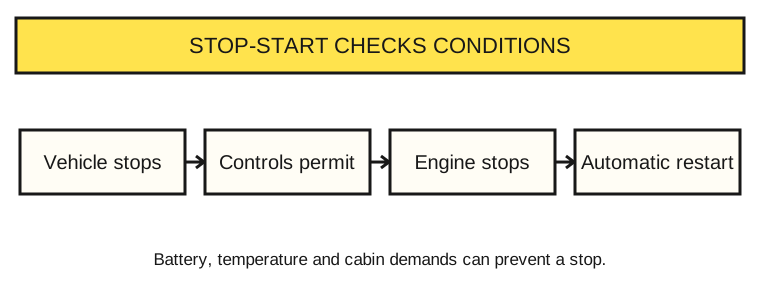
Not stopping every time can be expected behavior
In Ford’s cited example, the control logic considers operating conditions such as battery state, temperature, braking, and climate requirements. Other models set their own rules. The engine may remain running because an automatic stop is not permitted at that moment, even when the driver is waiting at a junction.
This also means one demonstration cannot establish whether a system is healthy. A missing automatic stop needs context, including the enabled state and the conditions listed in the manual. A warning or repeated failure under the correct conditions may require diagnosis, rather than a guess based on one traffic light.
Sources: Ford Motor Company, online owner manual ↗ · Federal Trade Commission ↗
Common misunderstandings
A dashboard start button and automatic stop-start are different features. A car can have one without the other. Automatic engine stopping also does not necessarily mean that an electric motor can propel the car as a full hybrid would.
Stop-start is not a substitute for the correct parking or maintenance shutdown procedure. Follow the manual whenever leaving the car or working around it. For buying, separate an expected automatic stop from an unexplained stall, then have any uncertainty resolved with the correct model information and professional assessment.
Sources: Ford Motor Company, online owner manual ↗ · U.S. Department of Energy ↗ · Federal Trade Commission ↗
Sources & review
Reviewed . Original educational explanation, checked against the sources below. This is general guidance; consult the documents for the exact vehicle, year, configuration, and market.
- Auto-Start-StopFord Motor Company, online owner manual · Enabling Auto-Start-Stop; Automatic Engine Restart; Disabling Auto-Start-Stop. Conditions and controls are model-specific examples. · Accessed 2026-10-23.
- Driving More EfficientlyU.S. Department of Energy / U.S. Environmental Protection Agency · FuelEconomy.gov · Observe the Speed Limit; Avoid Hauling Cargo on Your Roof. Government education; no percentage claims or artwork reproduced. · Accessed 2026-10-22.
- StartersDENSO Europe · How starters work; Fault finding. Installation instructions are not reproduced. · Accessed 2026-10-22.
- Buying a Used Car From a DealerFederal Trade Commission · Do Some Homework; Get an Independent Inspection Before You Buy; The Buyers Guide · Accessed 2026-10-22.
- How do I change an EFB or AGM battery?VARTA Automotive / Clarios · Approved replacement batteries and battery-management registration; procedures vary by vehicle · Accessed 2026-10-22.
- How Do Hybrid Electric Cars Work?U.S. Department of Energy · Alternative Fuels Data Center · Introduction, Electric generator, and Transmission · Accessed 2026-10-22.