The short answer
Regenerative braking uses a drive motor as a generator while slowing the car. Some energy from the moving vehicle becomes electrical energy stored in the battery. It recovers part of energy that friction brakes would otherwise turn into heat. It cannot recover everything, and its available slowing effect can change.
The drive motor can work in the other direction
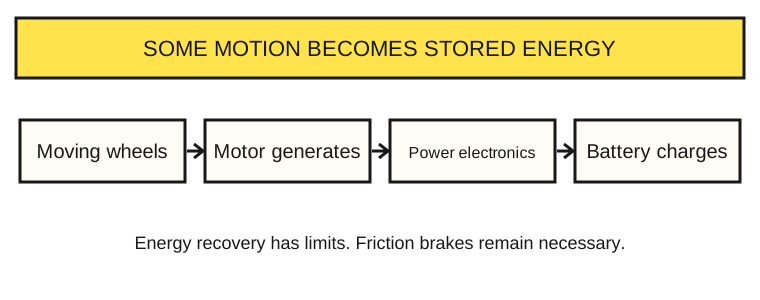
During powered acceleration, electrical energy helps the motor turn the wheels. During regeneration, wheel motion drives the motor as a generator. The resulting electrical output passes through the vehicle’s power-control system toward the battery. Taking energy from motion contributes to slowing the car.
Friction brakes use contact between friction surfaces to turn motion into heat. Regeneration provides another path for some of that energy. Conversion and storage still involve losses, so repeated acceleration and regeneration do not create free energy. Avoiding unnecessary speed changes remains different from recovering energy after making them.
Sources: U.S. Department of Energy ↗ · U.S. Department of Energy ↗ · Brembo Parts ↗
The battery and controls set limits
A battery cannot accept unlimited charging power. Regeneration may be reduced when the battery is very full or cold. Other operating conditions and traction control can also affect it. The exact warnings and any automatic friction-brake compensation depend on the vehicle’s design and settings.
The driver may request slowing by easing off the accelerator, pressing the brake pedal, or using another control. A vehicle can blend regenerative and friction braking. Do not infer the blend from pedal position alone. Read the manual for the particular model, including what changes when regeneration is limited.
Sources: Tesla ↗ · National Highway Traffic Safety Administration ↗
Common misunderstandings
One-pedal driving is a control feature, not a promise that the brake pedal is unnecessary. Its ability to slow or stop, and the conditions under which it operates, depend on the car. Stay ready to brake as the manual requires.
Regeneration does not recharge the battery without taking energy from somewhere. On a descent, gravity supplies energy as altitude decreases. On level ground, recovering energy from motion reduces speed. Neither case means that a car can repeatedly recharge itself without an external energy source or fuel.
Sources: Tesla ↗ · U.S. Department of Energy ↗ · U.S. Department of Energy ↗
Sources & review
Reviewed . Original educational explanation, checked against the sources below. This is general guidance; consult the documents for the exact vehicle, year, configuration, and market.
- How Do All-Electric Cars Work?U.S. Department of Energy · Alternative Fuels Data Center · Introduction and Key Components of an All-Electric Car · Accessed 2026-10-22.
- How Do Hybrid Electric Cars Work?U.S. Department of Energy · Alternative Fuels Data Center · Introduction, Electric generator, and Transmission · Accessed 2026-10-22.
- What causes brake discs to overheat and how to avoid itBrembo Parts · Friction, heat, and brake performance · Accessed 2026-10-22.
- Braking and Stopping — Model S Owner’s ManualTesla · Regenerative Braking: cold or full battery limits; friction-brake maintenance. Model-specific controls not generalized. · Accessed 2026-10-22.
- Electric and Hybrid VehiclesNational Highway Traffic Safety Administration · Battery Lifespan and Types; Batteries and Temperature. Thermal management energy use; no lifespan prediction adopted. · Accessed 2026-10-22.
- Buying a Used Car From a DealerFederal Trade Commission · Do Some Homework; Get an Independent Inspection Before You Buy; The Buyers Guide · Accessed 2026-10-22.
- Maintenance and Safety of Electric VehiclesU.S. Department of Energy · Alternative Fuels Data Center · Maintenance Comparison and Battery Maintenance · Accessed 2026-10-22.