The short answer
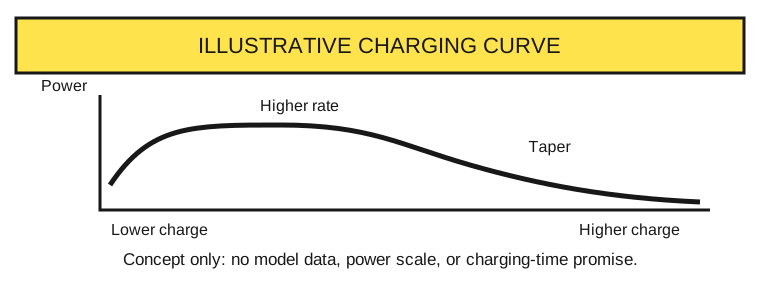
Charging power changes during a session. The car requests power within its current limits, and the equipment must be able to supply it. Battery charge level, temperature, and other conditions affect the result. A charging curve shows how power changes, often against state of charge. Peak power is only one point on that curve.
The vehicle and charging equipment share the limit
A station’s advertised power describes capability under stated conditions. It does not force that power into every connected car. The vehicle’s current charging allowance and the equipment’s available output both matter. A lower session rate can therefore have more than one explanation.
Battery temperature and charge level influence the allowable rate. Charging commonly slows toward a high state of charge. BMW’s diagnostic bulletin illustrates these effects for listed vehicles; its exact thresholds and restrictions are not rules for every electric car. Compare the actual car’s instructions and specifications.
Sources: BMW of North America, hosted by NHTSA ↗ · U.S. Department of Transportation ↗ · U.S. Department of Energy ↗
Power is a rate; energy is an amount
A kilowatt, abbreviated kW, measures power. A kilowatt-hour, abbreviated kWh, measures energy. Multiplying average power by time gives energy when the measurement points match. Peak power cannot replace the average if the rate changes during the session.
For an illustrative battery-side calculation, adding 30 kWh at an average 60 kW takes half an hour. This is arithmetic, not a vehicle charging claim. A real estimate needs the charging curve, conditions, losses where relevant, and the chosen starting and ending charge levels. Setup and waiting time add separate journey considerations.
Sources: U.S. Environmental Protection Agency ↗ · NASA Glenn Research Center ↗ · BMW of North America, hosted by NHTSA ↗
Common misunderstandings
A larger station rating does not guarantee a faster session once the car’s own allowance is the limit. Temperature preparation may help under suitable conditions, but it cannot make every battery accept unlimited power.
Charging from nearly full to full is not necessarily a fair test of maximum charging performance. It can also be a poor basis for comparing journey stops. Use a relevant, clearly described charge window and repeatable conditions. Keep connector compatibility, power capability, actual rate, and price as separate questions.
Sources: BMW of North America, hosted by NHTSA ↗ · U.S. Department of Transportation ↗ · U.S. Department of Energy ↗
Sources & review
Reviewed . Original educational explanation, checked against the sources below. This is general guidance; consult the documents for the exact vehicle, year, configuration, and market.
- BEV — Reasons for No/Slow DC Charging Complaint, SIB 61 25 23BMW of North America, hosted by NHTSA · PDF pages 6-9: charge level, allowable power and temperature; page 15: illustrative charging curve; page 16: preconditioning. Listed-vehicle thresholds and repeated-DC limits not generalized. · Accessed 2026-10-23.
- Charger Types and SpeedsU.S. Department of Transportation · Overview of EV Chargers; notes 1 and 6. Federal education: variable rates and slowing near full only. Dated connector coverage and timing estimates excluded. · Accessed 2026-10-23.
- Electric Vehicle Charging StationsU.S. Department of Energy · Alternative Fuels Data Center · Charging Equipment: AC Level 1, AC Level 2, DC Fast Charging; charging-time variables · Accessed 2026-10-22.
- Plug-in Electric Vehicle Charging: The DetailsU.S. Environmental Protection Agency · Volts, Amps, and Watts. Oh My.: battery capacity, power limits and range calculation · Accessed 2026-10-22.
- What is Power?NASA Glenn Research Center · Definition of power and units · Accessed 2026-10-22.
- Buying a Used Car From a DealerFederal Trade Commission · Do Some Homework; Get an Independent Inspection Before You Buy; The Buyers Guide · Accessed 2026-10-22.