The short answer
An exhaust system carries combustion gases away from the engine. It can also reduce noise and use treatment devices to reduce particular pollutants. A catalytic converter changes certain gases through chemical reactions. Different engines and markets use different combinations of equipment. A quiet exhaust is not proof of low emissions or good condition.
Different components solve different problems
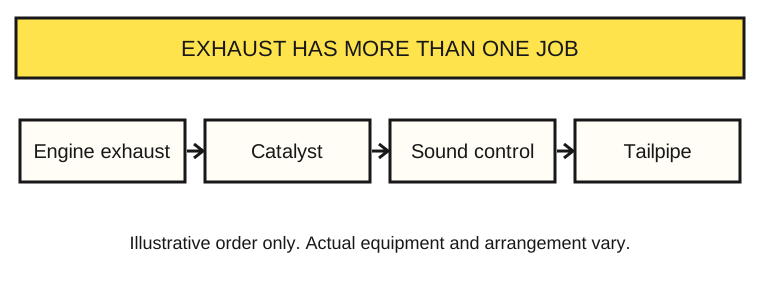
Burning fuel leaves gases that must exit the cylinders. Exhaust passages and pipes route these gases through the fitted equipment. A muffler, also called a silencer, reduces exhaust noise. Its job differs from the chemical treatment performed by a catalytic converter.
A catalyst promotes chemical reactions without serving as the fuel for those reactions. A converter can reduce targeted pollutants, but it does not make combustion disappear. Carbon dioxide still leaves a fuel-burning vehicle. The type and arrangement of treatment equipment depend on fuel, engine design, model year, and emissions specification.
Sources: Walker Exhaust Systems ↗ · New York State Department of Environmental Conservation ↗ · U.S. Department of Energy ↗
Monitoring helps reveal faults, not every detail of condition
Many modern cars monitor emissions-related operation through on-board diagnostics. Sensors and control software help identify abnormal behavior. A warning or stored code gives a starting point for diagnosis. It does not always identify one component that must be replaced.
The exhaust also needs physical integrity. A damaged converter, leaking joint, or corroded pipe presents a different question from a sensor fault. Inspection may need both a physical examination and diagnostic checks. A seller’s recent reset of the warning light is not evidence that the original problem was repaired.
Sources: U.S. Environmental Protection Agency ↗ · Oregon Department of Environmental Quality ↗ · New York State Department of Environmental Conservation ↗
Common misunderstandings
Louder does not automatically mean more powerful, and quieter does not automatically mean cleaner. Noise control and pollution treatment are separate functions. Ask what any modification changes, whether the required equipment remains, and whether the car meets the rules where you will use it.
A catalytic converter is not the same as a diesel particulate filter. A filter catches particles; other treatment stages address gases. An electric car without a combustion engine has no combustion exhaust, although tire wear and other sources of environmental impact still exist. Avoid treating ‘no tailpipe’ as a complete lifecycle comparison.
Sources: New York State Department of Environmental Conservation ↗ · U.S. Department of Energy ↗ · U.S. Department of Energy ↗ · California Air Resources Board ↗
Sources & review
Reviewed . Original educational explanation, checked against the sources below. This is general guidance; consult the documents for the exact vehicle, year, configuration, and market.
- What Does the Exhaust System Do?Walker Exhaust Systems · Primary functions: gas routing, catalytic treatment, noise control · Accessed 2026-10-22.
- Controlling Air Pollution From Motor VehiclesNew York State Department of Environmental Conservation · Catalytic Converters: chemical conversion and faults. New York legal rules and warranties are not generalized. · Accessed 2026-10-22.
- How Do Diesel Vehicles Work?U.S. Department of Energy · Alternative Fuels Data Center · Introduction and Key Components of a Light-Duty Diesel Vehicle · Accessed 2026-10-22.
- Frequently Asked Questions About On-Board DiagnosticsU.S. Environmental Protection Agency · EPA 420-F-97-003 · What Is OBD And How Does It Work?; How Does OBD Inform Drivers Of Problems?; Why Does The Dashboard Light Blink Or Flash? · Accessed 2026-10-22.
- On-board Diagnostics Frequently Asked QuestionsOregon Department of Environmental Quality · Readiness status, unready and drive cycles; diagnostic trouble codes; flashing check engine light · Accessed 2026-10-22.
- Buying a Used Car From a DealerFederal Trade Commission · Do Some Homework; Get an Independent Inspection Before You Buy; The Buyers Guide · Accessed 2026-10-22.
- How Do All-Electric Cars Work?U.S. Department of Energy · Alternative Fuels Data Center · Introduction and Key Components of an All-Electric Car · Accessed 2026-10-22.
- Brake & Tire Wear EmissionsCalifornia Air Resources Board · Opening explanation of exhaust and non-exhaust particle sources · Accessed 2026-10-22.