The short answer
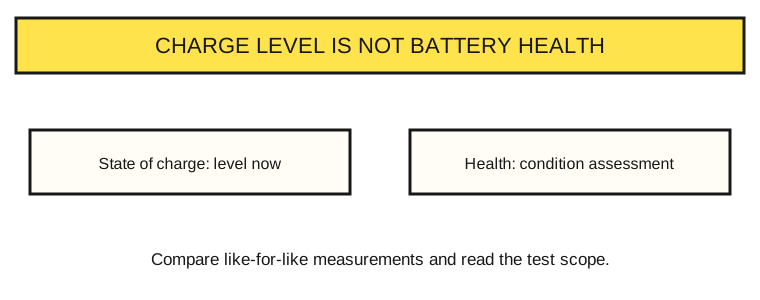
Battery health information describes aspects of the battery’s condition, while state of charge describes its present energy level. A useful assessment identifies what was measured, how it was measured, and the correct comparison baseline. A full charge or a favorable dashboard range estimate does not establish complete battery condition.
Charge level and retained capacity answer different questions
The charge display describes the battery’s current level within the range managed by the car. Capacity concerns how much energy that managed range can hold. A battery can reach a displayed full charge even if its available capacity differs from when it was new.
Tesla’s cited Model 3 manual describes health information in terms of energy retention relative to new. That is one manufacturer’s approach with specific test and availability conditions. Another car or test provider may define its result differently. Do not compare percentages without knowing their meaning and reference.
Sources: Tesla, Model 3 Owner’s Manual ↗ · U.S. Environmental Protection Agency ↗ · U.S. Department of Energy ↗
Read the report’s method and limitations
Ask whether the result came from a manufacturer function, a diagnostic estimate, or a measured energy test. Read its conditions and stated uncertainty. Battery management and calibration can affect estimates, so the procedure matters alongside the final number. Do not prescribe one brand’s health-test sequence for another car.
An estimated driving range is another kind of information. Weather, speed, terrain, and cabin demands affect distance per unit of energy. A range display cannot isolate capacity from all those factors. A normal drive is useful for assessing the car, but it is not automatically a controlled battery-capacity test.
Sources: Tesla, Model 3 Owner’s Manual ↗ · U.S. Environmental Protection Agency ↗ · U.S. Department of Energy ↗
Common misunderstandings
A full charge is not the same as full original capacity. Equally, some capacity change is not proof that the car cannot meet your needs. Compare available energy and realistic consumption with your journeys, while keeping uncertain findings visible.
A favorable report cannot guarantee future condition or rule out every fault. Its value lies in the questions it actually answers. Keep service history, inspection scope, charging compatibility, and warranty terms separate, then combine that evidence into a buying decision.
Sources: Tesla, Model 3 Owner’s Manual ↗ · U.S. Department of Energy ↗ · Federal Trade Commission ↗ · Tesla Support ↗
Sources & review
Reviewed . Original educational explanation, checked against the sources below. This is general guidance; consult the documents for the exact vehicle, year, configuration, and market.
- High Voltage Battery HealthTesla, Model 3 Owner’s Manual · Introduction; Understanding Results. Energy retention relative to new; test and availability remain model-specific. · Accessed 2026-10-23.
- Plug-in Electric Vehicle Charging: The DetailsU.S. Environmental Protection Agency · Volts, Amps, and Watts. Oh My.: battery capacity, power limits and range calculation · Accessed 2026-10-22.
- Maintenance and Safety of Electric VehiclesU.S. Department of Energy · Alternative Fuels Data Center · Maintenance Comparison and Battery Maintenance · Accessed 2026-10-22.
- Electric & Plug-In Hybrid Electric VehiclesU.S. Environmental Protection Agency · Driving Range · Accessed 2026-10-22.
- Winterizing Your Electric VehicleU.S. Department of Energy · Heat pump versus resistance heating; battery preconditioning and cabin warming. Federal education used as factual base; no illustrations reproduced. · Accessed 2026-10-22.
- Buying a Used Car From a DealerFederal Trade Commission · Do Some Homework; Get an Independent Inspection Before You Buy; The Buyers Guide · Accessed 2026-10-22.
- Vehicle WarrantyTesla Support · Battery and Drive Unit Limited Warranty; transfer FAQ; finding actual vehicle coverage. No duration, percentage, transfer promise or market-wide rule adopted. · Accessed 2026-10-23.